
Films / Dark City
Film Review
Dark City
1998 · Dir. Alex Proyas · Sci-fi / Neo-noir · 100 min
A city that reshapes itself at midnight. A man who can't remember his past. The wrongfully forgotten precursor to The Matrix.
Michael
Essential Cinema
Shawn
Pleasant Surprise
The reviews
M
Michael
The Film Snob
Essential Cinema
Alex Proyas built one of the most fully realized cinematic worlds of the 1990s and almost nobody noticed. Dark City arrived a year before The Matrix and covers much of the same philosophical ground — identity, control, the constructed nature of reality — with a visual vocabulary that owes more to German Expressionism and noir than to Hong Kong action cinema.
The film's central conceit is audacious: a city perpetually frozen in nighttime, its streets rearranged every midnight by pale, bald figures called the Strangers, who inject memories into sleeping humans like rats in a maze. Rufus Sewell plays John Murdoch, a man who wakes up with no memories beside a dead woman, and spends the film outrunning both the police and something far stranger.
What Proyas achieves here — on a modest budget — is atmosphere so thick you could cut it. The sets are theatrical but intentionally so; this is a world built on lies, and the artifice is the point. Kiefer Sutherland's performance as Dr. Schreber is a masterclass in controlled unease.
The Director's Cut (1998, available on streaming) removes the studio-mandated opening voiceover that spoils the film's central mystery, and is the definitive version. Watch that one.
S
Shawn
The Common Man
Pleasant Surprise
Warning — there are spoilers.
The theatrical cut opens with a voice-over that essentially hands you the ending before the movie has even said hello — it ranks among the great acts of studio self-sabotage. The director's cut removes that narration and trusts you to find your footing in the dark alongside the protagonist. That's the version I'm reviewing.
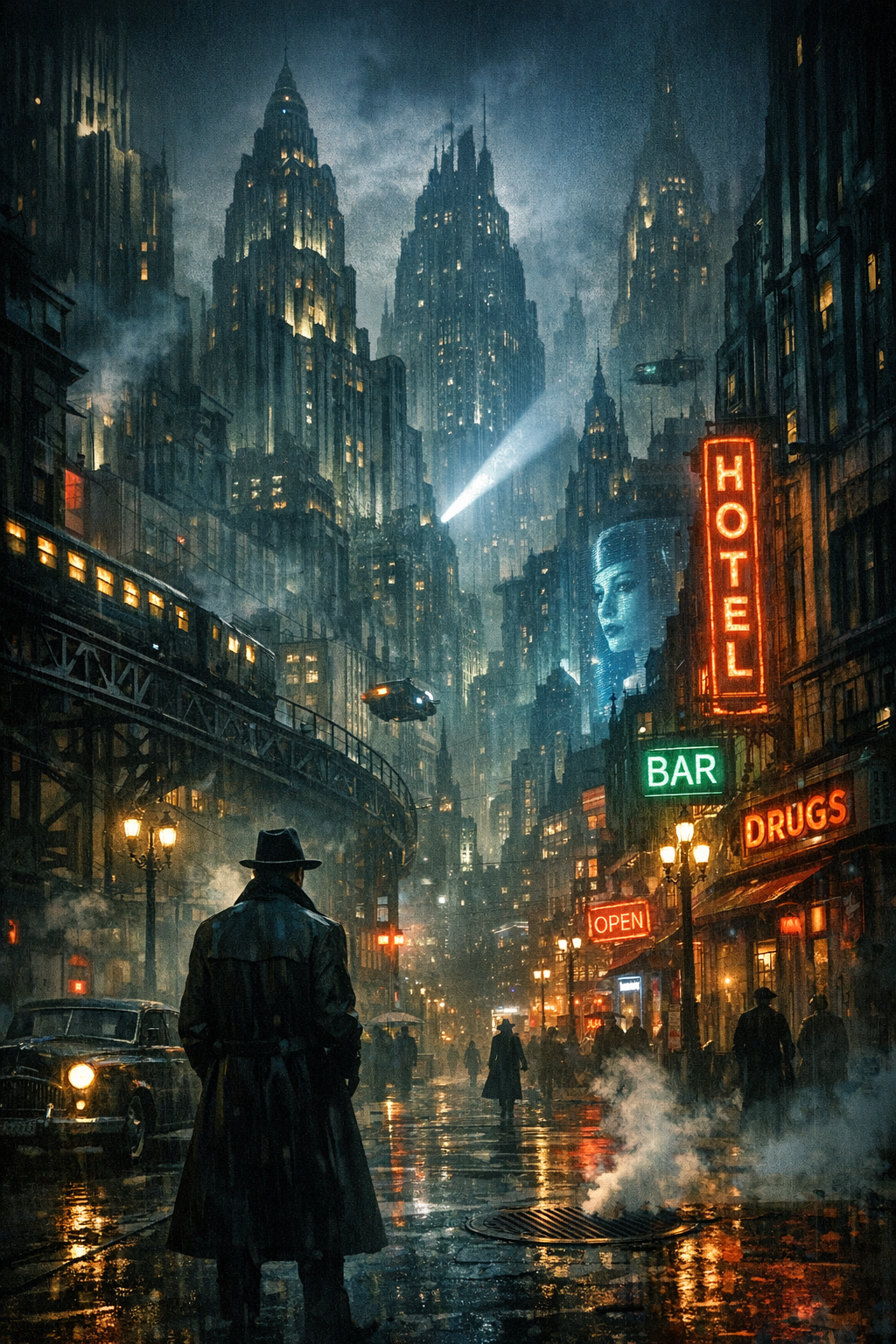
Alex Proyas builds a city out of borrowed nightmares. The skyline is Fritz Lang's Metropolis filtered through forties noir. The perpetual midnight, the trench coats, the rain-slicked streets — they're assembled from the collective memory of every shadowy film you've half-remembered at 2 a.m. The cinematography, production design, and practical effects are legitimately extraordinary. The makeup on the Strangers alone — pale, cadaverous, dressed like undertakers who moonlight as gods, part Cenobite, part hive-mind, part mad scientist — sets the tone. You take one look at them and understand immediately that something is very wrong with this world.
The premise is elegant and mean: every night at midnight, the city stops. The population falls unconscious. Alien beings rearrange the architecture — buildings shift, walls grow, identities get swapped like trading cards — and then everyone wakes up in a life they didn't live yesterday. It is one of the great high-concept setups in nineties science fiction, and Proyas makes it feel as disorienting to watch as it would be to live through. Trevor Jones's score pulses underneath everything like a second heartbeat, and the sound design during the "tuning" sequences carries real physical weight.
The plot does not fully hold together. If the Strangers can rewrite memories wholesale, there's no coherent reason they also need to commit murders — yet the film opens with one and treats it as the inciting mystery. There are other nitpicky things: if the city is floating in space, what about gravity, food supply, why no one has ever found the edge? But — and this is a compliment to the film — I was so engrossed that I didn't care.
Now the bad. Dark City has a pacing problem: long passages that, while visually impressive, don't move the story forward. Late in the film a minor character shows up entirely to explain what's happening, and then dies. It is an exposition dump in a trench coat — an inelegant screenwriting shortcut. The film is genuinely atmospheric and should have allowed its mystery to gradually unravel. The ending felt rushed and was a bit of an unearned superhero showdown.
Jennifer Connelly is the female lead. I could enjoy watching her do essentially nothing — walk across a room, stand in a doorway, hold a glass. Dark City tests that theory. She has little to work with here but she brings a grounded presence to her scenes anyway. Her talents were better served in Career Opportunities and The Rocketeer. Meanwhile, Melissa George (Mulholland Drive, Alias, 30 Days of Night, In Treatment) is charismatic in a small role, and William Hurt is having fun playing a hard-boiled detective who isn't in on the game. Kiefer Sutherland makes a very specific choice with his voice — apparently going for Renfield-serving-Dracula — that I am still processing.
I am bothered by plot holes that others wouldn't notice. Dark City has a few. But the film put a fascinating weird city in my head and asked real questions about identity and memory through imagery rather than just dialogue. That counts for a great deal.
Watch the director's cut. The ideas, visuals, and atmosphere are exceptional — the exposition and pacing make it a 4 out of 6 for me, but those less picky about plot loopholes might give it a 5 or even a 6.